Research library Verifying Before You Buy
Lot records
What Should a Public Batch Record Contain?
Article
Verifying Before You Buy · 6 MIN READ · QUALITY
01 / Overview
What the public record is for
A public batch record links a lot number to the analytical summary that was filed for that lot. It is documentation first - not a marketing summary. Its purpose is to let a reader who holds a vial, or is considering one, check what was tested, by whom, and when, without asking the seller.
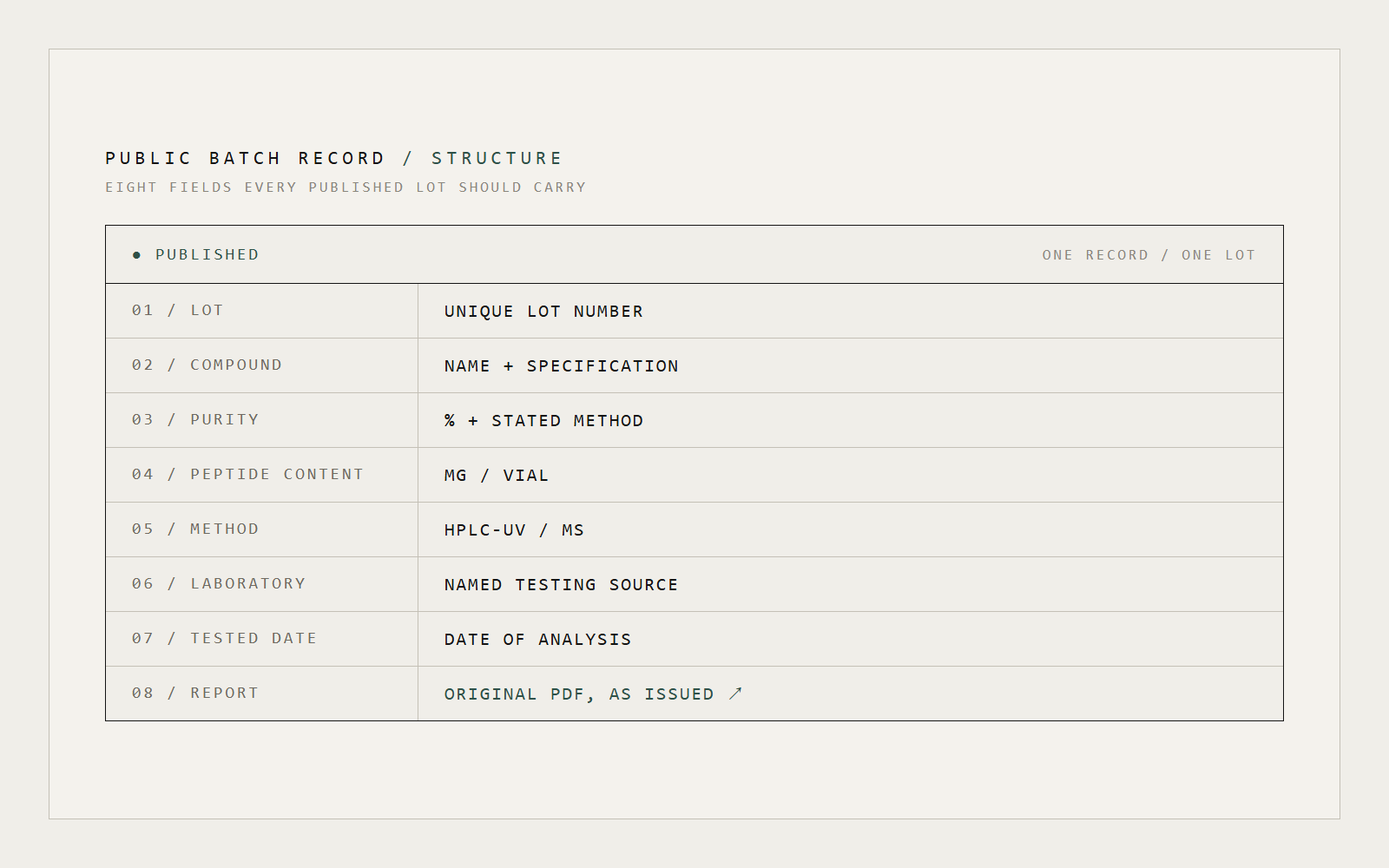
The fields that identify the lot
Lot number: the exact string printed on the vial label, because it is the key that connects the physical material to the record. Compound and strength: what the lot is stated to contain. Status: whether the record is published, pending or unavailable. A record that cannot be tied to one specific lot describes a product line, not a batch.
The fields that describe the testing
Laboratory: the name of the organization that performed the analysis, so that a reader can tell third-party work from in-house work. Method: the technique behind each figure, since a purity value means little without it [1]. Tested date: when the analysis was performed. Report number: the identifier the laboratory assigned, where one exists.
The values
Purity is reported as a number under its stated method. Peptide content appears beside purity when the report includes a net peptide or fill assay; otherwise the field displays a dash. Fields for which no test was performed are shown as empty rather than omitted, so that the absence is visible.
The source document
The summary on the page is a transcription, and transcriptions can be wrong. The original laboratory report, as a PDF, is the source document, and the record gives a path to it when the lot is published. Where the page and the PDF disagree, the PDF governs.
What a record should not do
It should not present a pending lot with values, carry one report across several lots, or replace numbers with the word "pass". Each of these removes the ability to check.
The market supplies the cautionary examples. Laboratories analyzing peptide products from unregulated channels have documented materials whose actual composition did not match any paperwork offered for them [2][3]. A public record structured as above is the opposite design: published before the question is asked, tied to one lot, and anchored to a report its laboratory will acknowledge.
How should a batch record be used before buying?
Three reads, in order. First, existence: the lot being offered appears in the ledger at all, with a published status. Second, coherence: the compound, strength and dates match the listing, and the method appears next to each value. Third, traceability: the laboratory is named, and the report number resolves - on the laboratory's verification page where one exists, or by inquiry. A vendor can pass the first two reads with good formatting; only a real testing program passes the third.
How should it be used after receiving a vial?
Match the vial label's lot number to its record, confirm the certificate shipped with the vial carries the same lot number and report number, and spot-check one value - the observed mass against the compound's published mass is the quickest. Discrepancies at this stage are documentation failures even when the material is fine, and a vendor's response to a documentation question is itself informative.
How FLASK records are structured
FLASK batch records are built on the fields above. Lots appear in the ledger once a third-party report has been filed for them; until then the ledger states that first lots are in testing.
Frequently asked questions
Which document governs if the page and the PDF disagree?
The original laboratory report as a PDF is the source document. The page is a transcription, and where the two disagree the PDF governs.
What does an empty field on a batch record mean?
The test was not part of the report. Fields are shown as empty rather than omitted so that the absence is visible.
Can one laboratory report cover several lots?
No. A record that cannot be tied to one specific lot describes a product line, not a batch.
Why publish batch records at all?
Because published-in-advance records cannot be tailored to a question after it is asked. A ledger visible to everyone, lot by lot, is harder to curate than documents produced on request.
What is the quickest single check on a record?
The observed mass against the compound's published molecular weight. It requires no account, no inquiry and no trust in the seller - only a reference value and the record itself.
Figure
Structure of a batch record
Each field on the public page traces back to the laboratory report. The page shows the filed summary; the PDF remains the source document.
Illustrative analytical trace
What to review
- Lot number Exact match to the vial label.
- Purity Reported under the stated method.
- Peptide content Mass per vial when reported.
Footnotes & references
References
- United States Pharmacopeia. General Chapter Chromatography.
- The occurrence of putative cognitive enhancing research peptides in seized pharmaceutical preparations. Vanhee C, Francotte A, et al. Drug Test Anal. 2020;12(3). PMID: 31667971.
- Impurity profiling of the most frequently encountered falsified polypeptide drugs on the Belgian market. Talanta. 2018;189:95-105. PMID: 30029448.
Related products & records
Read the specification and the record
Use the lot record and testing pages for the source analytical documentation.
Related reading